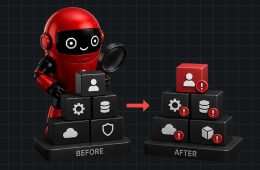
Many organizations invest in cloud security posture management (CSPM) expecting that alerts alone will ensure compliance. In practice, this rarely happens. Alerts highlight issues—but compliance requires structure, validation, and proof.
This gap between detection and readiness is where most teams struggle. The problem is not the absence of signals, but the lack of a system to convert those signals into audit-aligned outcomes.
Why Alerts Feel Like Progress—but Aren’t Enough
CSPM platforms generate large volumes of alerts:
- Misconfigurations
- Policy violations
- Exposure risks
While these are important, they are still raw inputs. Compliance, on the other hand, is based on:
- Control validation
- Consistent enforcement
- Documented evidence
An alert indicates a problem. It does not confirm that a control is implemented, enforced, and auditable.
The Core Disconnect: Alerts vs Compliance
Alerts are event-driven. Compliance is framework-driven.
This creates a mismatch:
- Alerts are technical (e.g., “S3 bucket is public”)
- Compliance is contextual (e.g., “Data must not be publicly accessible under policy X”)
Without mapping alerts to specific compliance controls, organizations cannot prove readiness during a cloud compliance audit.
1. Alerts Lack Context and Prioritization
Not all alerts are equally important for compliance.
Common issues:
- High volumes of low-priority alerts
- No clear mapping to regulatory frameworks
- Difficulty identifying which issues impact audit outcomes
This leads to alert fatigue, where critical compliance risks are buried among less relevant findings.
2. No Direct Mapping to Compliance Frameworks
CSPM alerts often exist in isolation from frameworks like SOC 2, ISO 27001, or GDPR.
Without mapping:
- Teams fix issues without knowing if they impact compliance
- Auditors cannot trace controls to actual configurations
- Reporting becomes fragmented
A mature cloud security posture requires that every finding aligns with a defined control requirement.
3. Alerts Do Not Ensure Policy Enforcement
An alert indicates a violation—but does not enforce correction.
Typical gaps:
- Issues are acknowledged but not remediated
- Policies exist but are not consistently applied
- New resources bypass existing controls
Compliance requires enforced, repeatable policies—not just detection.
4. Lack of Continuous Validation
Fixing an alert once does not guarantee ongoing compliance.
Problems arise when:
- Configurations drift over time
- Manual fixes are not standardized
- No continuous monitoring is in place
A strong cloud security posture management approach ensures that controls are continuously validated, not just temporarily corrected.
5. Missing Audit-Ready Evidence
Alerts do not provide proof of compliance.
Auditors require:
- Historical records of control enforcement
- Logs and configuration snapshots
- Evidence of consistent policy application
Without automated evidence collection, organizations struggle to demonstrate compliance—even if issues have been resolved.
6. No Pre-Audit Validation Layer
Many teams rely solely on alerts without conducting a structured review before audits.
A cloud security posture review (CSPR) fills this gap by:
- Validating controls against compliance frameworks
- Identifying unresolved risks
- Ensuring readiness before formal audits
Without this step, teams enter audits with uncertainty.
7. Fragmented Visibility Across Environments
In multi-cloud setups, alerts are often scattered across platforms.
This creates:
- Inconsistent policy enforcement
- Gaps in visibility
- Difficulty maintaining unified compliance
Effective multi-cloud governance requires centralized visibility and control, not isolated alert streams.
8. Alerts Without Remediation Workflows
Detection without action does not improve compliance.
Common challenges:
- No defined ownership for fixing issues
- Lack of automated remediation
- Delayed response to critical risks
Organizations that integrate remediation workflows into their CSPM processes are significantly more prepared for audits.
Moving from Alerts to Compliance Readiness
To bridge the gap, organizations need to move beyond alert-driven security.
Key shifts include:
- Mapping alerts to compliance controls
- Prioritizing findings based on audit impact
- Enforcing policies consistently
- Automating remediation where possible
- Collecting audit-ready evidence continuously
This transforms alerts from noise into actionable compliance signals.
Final Thoughts
CSPM alerts are necessary—but not sufficient—for compliance readiness. They provide visibility into risks, but they do not guarantee that controls are implemented, enforced, or auditable.
By combining continuous monitoring with structured validation, policy enforcement, and periodic posture reviews, organizations can turn fragmented alerts into a cohesive compliance strategy.
When detection is connected to enforcement and evidence, cloud security posture management becomes more than a monitoring tool—it becomes a foundation for consistent, audit-ready security.