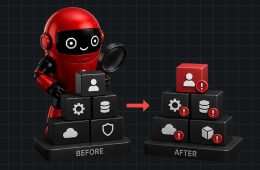
As organizations expand across AWS, Azure, and GCP, multi-cloud environments introduce flexibility—but also complexity. This complexity becomes most visible during audits, where inconsistencies, gaps, and lack of centralized control are quickly exposed.
Audit failures in multi-cloud setups are rarely due to a single issue. They stem from fragmented visibility, inconsistent policy enforcement, and difficulty proving compliance across platforms.
This guide outlines the most common multi-cloud security challenges in audits and how to address them using a structured cloud security posture management (CSPM) approach.
Why Multi-Cloud Makes Audits Harder
Each cloud provider has its own:
- Configuration models
- Security controls
- Logging mechanisms
- Compliance mappings
Without a unified approach, teams end up managing security in silos. This leads to gaps that are difficult to detect until audit time.
Challenge 1: Fragmented Visibility Across Cloud Environments
One of the most common issues is the lack of a centralized view.
Teams often struggle with:
- Separate dashboards for each cloud provider
- Incomplete asset inventories
- Limited visibility into cross-cloud resources
This makes it difficult to answer basic audit questions about what exists and how it is secured.
How to solve it:
Establish unified visibility across all environments. A centralized cloud security posture view ensures that all assets, configurations, and risks are continuously tracked.
Challenge 2: Inconsistent Policy Enforcement
Security policies are often defined centrally but implemented differently across platforms.
Common gaps:
- Different IAM configurations across clouds
- Inconsistent encryption standards
- Variations in network security rules
This inconsistency leads to compliance failures, even if policies exist on paper.
How to solve it:
Standardize policies and enforce them uniformly. A strong security posture management strategy ensures consistent control implementation across all cloud environments.
Challenge 3: Different Compliance Mappings Across Providers
Each cloud provider maps controls differently to compliance frameworks like SOC 2, ISO 27001, or GDPR.
This creates:
- Confusion in control validation
- Gaps in compliance coverage
- Difficulty generating unified reports
How to solve it:
Use a normalized control framework that maps configurations across providers into a single compliance model. This simplifies cloud compliance audit preparation and reporting.
Challenge 4: Disjointed Logging and Monitoring
Logs are essential for audits, but in multi-cloud environments they are often scattered.
Typical issues:
- Logs stored in different formats and locations
- Inconsistent retention policies
- Lack of centralized alerting
Without unified logging, proving compliance becomes difficult.
How to solve it:
Centralize logging and monitoring across all cloud platforms. Continuous monitoring ensures that security events are tracked consistently and can be audited effectively.
Challenge 5: Configuration Drift Across Environments
Even if environments start aligned, they diverge over time.
Drift occurs due to:
- Independent team deployments
- Manual configuration changes
- Lack of centralized enforcement
This leads to inconsistent security states across clouds.
How to solve it:
Implement continuous monitoring and drift detection through cloud security posture management. This ensures that deviations are identified and corrected in real time.
Challenge 6: Difficulty in Evidence Collection
Audits require structured, verifiable evidence across all environments.
In multi-cloud setups:
- Evidence is spread across multiple systems
- Data formats differ
- Manual collection is time-consuming
This slows down audit processes and increases the risk of missing documentation.
How to solve it:
Automate evidence collection across all cloud platforms. Centralized reporting simplifies audit preparation and ensures consistency.
Challenge 7: Lack of Pre-Audit Validation
Teams often enter audits without validating their entire multi-cloud environment.
This leads to:
- Unexpected compliance gaps
- Incomplete control validation
- Increased audit pressure
How to solve it:
Conduct a unified cloud security posture review (CSPR) across all environments. This ensures that controls are validated consistently before the audit begins.
Challenge 8: Siloed Security Operations
Different teams may manage different cloud environments.
This creates:
- Inconsistent processes
- Lack of shared accountability
- Gaps in remediation workflows
How to solve it:
Adopt centralized governance and shared workflows. Strong multi-cloud governance ensures alignment across teams and environments.
Challenge 9: Alert Overload Without Context
Multi-cloud environments generate large volumes of alerts.
Problems include:
- Duplicate alerts across platforms
- Lack of prioritization
- No clear mapping to compliance requirements
This reduces effectiveness and slows response times.
How to solve it:
Prioritize alerts based on compliance impact, not just severity. This ensures that critical audit-related issues are addressed first.
What Effective Multi-Cloud Audit Readiness Looks Like
Organizations that handle multi-cloud audits effectively follow a consistent model:
- Centralized visibility across all cloud assets
- Uniform policy enforcement
- Continuous compliance monitoring
- Automated evidence collection
- Regular posture reviews
In these environments, audits become structured and predictable rather than complex and reactive.
Final Thoughts
Multi-cloud environments increase flexibility—but they also increase the risk of audit failures if not managed properly.
By addressing fragmentation, enforcing consistency, and adopting a unified cloud security posture management approach, organizations can simplify compliance and reduce audit risk.
When visibility, control, and validation are centralized, multi-cloud audits shift from being a challenge to a manageable, repeatable process.