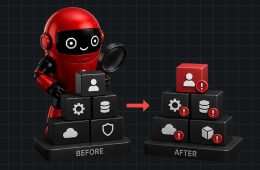
Most cloud security teams prioritize risks based on severity—critical, high, medium, low. While this works for general security operations, it often fails in a compliance context.
Audits are not driven by severity alone. They are driven by whether specific controls are implemented, enforced, and provable. A “medium” severity issue can still cause an audit failure if it violates a required control.
This guide explains how to shift from severity-based prioritization to compliance-driven prioritization using a structured cloud security posture management (CSPM) approach.
Why Severity Alone Is Not Enough
Severity reflects technical risk—how exploitable or impactful an issue might be.
Compliance, however, focuses on:
- Control adherence
- Policy enforcement
- Evidence of implementation
This creates a mismatch:
- A critical vulnerability may not map to a required control
- A lower-severity misconfiguration may directly violate a compliance requirement
Relying only on severity leads to misaligned priorities and audit gaps.
The Shift: From Severity to Compliance Impact
Instead of asking “How severe is this issue?”, teams should ask:
- Does this violate a compliance control?
- Is this control mandatory for our audit framework?
- Can we provide evidence that this is fixed and enforced?
This shift aligns risk prioritization with actual audit outcomes and strengthens overall cloud security posture.
Step 1: Map Risks to Compliance Controls
Every identified risk should be tied to a specific control from frameworks such as SOC 2, ISO 27001, or GDPR.
For example:
- Public storage exposure → Data protection control
- Missing MFA → Access control requirement
- Disabled logging → Monitoring and auditability requirement
Without this mapping, teams cannot determine which risks directly impact a cloud compliance audit.
Step 2: Classify Risks by Audit Impact
Once mapped, classify risks based on their impact on compliance:
- Direct violations: Clearly break required controls (highest priority)
- Supporting gaps: Indirectly weaken control effectiveness
- Best practice deviations: Improve security but may not impact audit outcome
This approach ensures that compliance-critical issues are addressed first, regardless of their technical severity.
Step 3: Consider Evidence Requirements
Some risks are easier to fix than to prove.
Auditors require:
- Logs
- Configuration history
- Proof of consistent enforcement
If a control cannot be demonstrated with evidence, it remains a compliance risk—even if technically resolved.
Prioritize issues where:
- Evidence is missing or incomplete
- Historical validation is required
- Continuous enforcement cannot be demonstrated
Step 4: Evaluate Exposure in Context
Not all risks exist in isolation.
Context matters:
- Is sensitive data involved?
- Is the resource publicly accessible?
- Does this impact production systems or test environments?
A moderate issue affecting critical systems may carry higher compliance risk than a severe issue in a non-sensitive environment.
Step 5: Factor in Configuration Drift
Compliance is not about one-time fixes.
Risks should also be prioritized based on:
- Likelihood of reoccurrence
- Frequency of configuration drift
- Lack of policy enforcement
A mature cloud security posture management strategy ensures that high-risk configurations are not only fixed but prevented from reappearing.
Step 6: Integrate Continuous Monitoring
Static prioritization quickly becomes outdated in dynamic environments.
Teams should:
- Continuously reassess risks
- Update priorities as environments change
- Align real-time findings with compliance controls
This ensures that prioritization reflects current risk, not outdated snapshots.
Step 7: Use Posture Reviews for Validation
Before audits, conduct a structured validation process.
A cloud security posture review (CSPR) helps:
- Confirm that high-priority risks are resolved
- Validate control implementation
- Identify gaps missed during regular monitoring
This step ensures that prioritization decisions hold up under audit conditions.
Step 8: Align Prioritization with Remediation Workflows
Prioritization is only effective if it leads to action.
Best practices include:
- Assigning ownership for compliance-critical risks
- Automating remediation for repeat issues
- Tracking resolution against compliance requirements
This creates a direct link between risk identification and compliance outcomes.
Common Mistakes to Avoid
Teams often fall into these patterns:
Focusing only on “critical” alerts without compliance context
Treating all risks equally without control mapping
Fixing issues without ensuring audit evidence
Ignoring lower-severity findings that violate key controls
Avoiding these mistakes improves both efficiency and audit success rates.
What Effective Prioritization Looks Like
Organizations that succeed take a structured approach:
- Risks are mapped to compliance controls
- Prioritization is based on audit impact
- Evidence is continuously collected
- Policies prevent recurring issues
- Monitoring is continuous, not periodic
This aligns security operations with compliance expectations and strengthens overall security posture management.
Final Thoughts
Prioritizing cloud security risks based solely on severity creates blind spots in compliance. What matters is not just how dangerous a risk is—but whether it violates a required control and can be proven as resolved.
By aligning prioritization with compliance impact and integrating it into a continuous cloud security posture management process, organizations can reduce audit risk and operate with greater clarity.
When prioritization reflects real compliance requirements, audits become predictable—and significantly easier to manage.