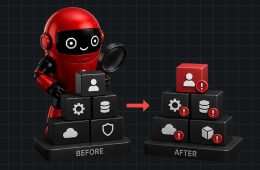
Most teams believe they are prepared for a cloud audit—until the audit actually begins. The gap is rarely due to lack of tools or effort. It comes from misunderstandings about what “audit-ready” truly means in a cloud environment.
Audit readiness is not about passing a checklist at a single point in time. It is about maintaining a continuously validated cloud security posture that aligns with compliance requirements and produces verifiable evidence on demand.
This is where many organizations go wrong.
The Misconception: Audit Readiness Is a One-Time Activity
A common assumption is that audit preparation can be handled just before the audit window.
In practice, this leads to:
- Last-minute configuration fixes
- Manual evidence collection
- Temporary compliance that does not reflect real operations
Cloud environments change too frequently for this approach to work. Without continuous validation through cloud security posture management (CSPM), configurations drift and controls weaken over time.
Mistake 1: Focusing on Tools Instead of Outcomes
Many teams invest in multiple security tools but still struggle during audits.
The issue is not capability—it is alignment.
Common problems:
- Tools generate alerts but are not tied to compliance controls
- No clear mapping between technical findings and audit requirements
- Lack of structured reporting
Audit readiness depends on outcomes—validated controls, enforced policies, and documented evidence—not just tool deployment.
Mistake 2: Lack of Complete Visibility
Teams often underestimate how fragmented their cloud environments are.
Typical gaps include:
- Untracked resources across accounts or regions
- Shadow IT deployments
- Incomplete asset inventories
Without full visibility, compliance checks are inherently incomplete. A strong security posture management approach requires continuous asset discovery and monitoring.
Mistake 3: Treating Misconfigurations as Isolated Issues
Misconfigurations are often addressed individually rather than systematically.
This leads to:
- Repeated violations
- Inconsistent fixes
- No long-term control improvement
Instead of reacting to individual issues, organizations should enforce policies that prevent misconfigurations at scale using CSPM tools.
Mistake 4: Weak Identity and Access Controls
Identity and access management remains one of the most common causes of audit findings.
Frequent issues:
- Excessive permissions
- Lack of role-based access control
- Missing multi-factor authentication
- Unused or long-lived credentials
These gaps directly impact compliance and are often flagged early in audits.
Mistake 5: No Continuous Compliance Monitoring
Many teams rely on periodic checks or manual reviews.
This creates:
- Blind spots between assessments
- Delayed detection of violations
- Increased risk of audit failure
Continuous monitoring is essential. A mature cloud security posture management strategy ensures that compliance is validated in real time, not just during scheduled reviews.
Mistake 6: Skipping Pre-Audit Validation
Going into an audit without internal validation is a recurring mistake.
A structured cloud security posture review (CSPR) helps:
- Identify compliance gaps in advance
- Validate controls against required frameworks
- Reduce surprises during the audit
Teams that skip this step often discover issues too late to address them effectively.
Mistake 7: Poor Evidence Collection Practices
Even when controls are implemented correctly, teams struggle to prove it.
Common challenges:
- Manual and time-consuming evidence gathering
- Missing historical data
- Inconsistent documentation
Auditors require clear, verifiable proof. Automating evidence collection is critical for efficient cloud compliance audit processes.
Mistake 8: Inconsistent Policy Enforcement Across Environments
In multi-cloud setups, maintaining consistency is difficult.
Challenges include:
- Different configurations across AWS, Azure, and GCP
- Lack of centralized governance
- Fragmented monitoring and reporting
Effective multi-cloud governance ensures that policies are applied uniformly, reducing compliance gaps.
Mistake 9: Ignoring Configuration Drift
Even well-configured environments degrade over time.
Drift occurs when:
- New resources are deployed without standard controls
- Manual changes bypass policies
- Teams operate independently without centralized oversight
Without continuous monitoring, these changes accumulate and impact audit readiness.
Mistake 10: Treating Compliance as a Checklist
Perhaps the most fundamental mistake is reducing compliance to a checklist exercise.
This mindset leads to:
- Minimal adherence to requirements
- Lack of long-term security improvement
- Reactive rather than proactive operations
Audit readiness should reflect actual security practices, not temporary adjustments made for compliance.
What Audit-Ready Actually Looks Like
Organizations that consistently pass audits operate differently.
They:
- Maintain continuous visibility across all cloud assets
- Enforce policies automatically
- Monitor compliance in real time
- Conduct regular posture reviews
- Generate audit-ready evidence continuously
In these environments, audits are not disruptive—they are routine validations.
Final Thoughts
Audit readiness in the cloud is not about preparing for an event—it is about maintaining a system that is always prepared.
By aligning continuous monitoring, policy enforcement, and structured validation through cloud security posture management, organizations can eliminate last-minute effort and reduce audit risk.
When cloud security is managed as an ongoing process rather than a periodic task, compliance becomes a natural outcome instead of a recurring challenge.