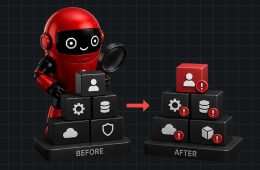
Most organizations don’t fail cloud security audits because they ignore security.
They fail because the same configuration mistakes appear again and again—often hidden inside fast-moving cloud environments. A public storage bucket, an over-permissioned IAM role, or disabled audit logging may exist for months before anyone notices.
The encouraging part is that these findings are usually preventable. They’re rarely caused by sophisticated attacks. They’re caused by gaps in configuration management, governance, and continuous monitoring.
Quick Answer
The most common cloud audit findings include publicly exposed storage, excessive IAM permissions, missing MFA, disabled logging, weak network security, missing encryption, configuration drift, unmanaged cloud assets, and poor governance. These issues persist because cloud environments change continuously, while many organizations still rely on periodic manual reviews instead of continuous monitoring.
Why These Same Findings Keep Appearing
Cloud providers offer secure infrastructure.
The responsibility for configuring that infrastructure securely belongs to you.
As cloud environments grow, infrastructure changes daily through deployments, Infrastructure as Code, and manual updates. Without continuous oversight, small configuration changes accumulate until they become audit findings—or worse, security incidents.
One pattern appears across almost every cloud audit: the issue isn’t that teams don’t know what good security looks like—it’s that they struggle to maintain it consistently.
1. Public Storage Buckets
Storage services such as Amazon S3, Azure Blob Storage, and Google Cloud Storage remain one of the most common audit findings.
Typical issues include:
- Public read access
- Public write permissions
- Sensitive data stored without proper access controls
Why auditors care
Public storage often leads directly to data exposure and compliance violations.
2. Over-Privileged IAM Roles
Permissions naturally grow over time.
Developers change projects, applications evolve, and temporary administrator access often becomes permanent.
Auditors regularly find:
- Administrator roles assigned unnecessarily
- Wildcard permissions
- Dormant privileged accounts
- Excessive service account permissions
Following least-privilege access remains one of the most effective ways to reduce cloud risk.
3. Missing Multi-Factor Authentication (MFA)
Privileged accounts without MFA continue to appear in audit reports.
This includes:
- Root accounts
- Global administrators
- Break-glass accounts
- Privileged IAM users
One compromised password should never provide unrestricted administrative access.
4. Open Security Groups and Firewall Rules
Temporary firewall rules often become permanent.
Common findings include:
- SSH open to the internet
- RDP exposed publicly
- Unrestricted inbound rules
- Unused firewall exceptions
These exposures dramatically increase the attack surface.
5. Disabled or Incomplete Audit Logging
Logging isn’t useful if it’s incomplete.
Auditors frequently identify:
- CloudTrail disabled
- Activity Logs not retained
- Missing regional coverage
- Critical services not being monitored
Without reliable logs, proving compliance and investigating incidents becomes much harder.
6. Missing Encryption
Encryption is one of the first controls auditors verify.
Common issues include:
- Unencrypted storage volumes
- Database encryption disabled
- Weak key management practices
- Backups stored without encryption
Encryption should be applied consistently—not selectively.
7. Configuration Drift
A secure cloud environment today doesn’t guarantee a secure environment next month.
Configuration drift occurs when cloud resources gradually move away from approved security baselines because of manual changes, emergency fixes, or inconsistent deployments.
Many audit findings are simply the result of configuration drift that went undetected.
8. Unmanaged Cloud Assets
Many organizations don’t have a complete inventory of their cloud resources.
Auditors often discover:
- Forgotten virtual machines
- Old snapshots
- Test environments
- Unused storage
- Orphaned resources
If you don’t know a resource exists, you can’t secure it.
9. Weak Resource Tagging and Ownership
This finding doesn’t always create an immediate security risk—but it creates operational problems.
Without proper ownership:
- Findings aren’t assigned.
- Resources aren’t reviewed.
- Remediation slows down.
- Audit evidence becomes harder to collect.
Every production resource should have a clearly identified owner.
10. Compliance Drift
Passing an audit doesn’t mean you’ll remain compliant.
New deployments, policy updates, or infrastructure changes can quietly violate security controls weeks after an assessment.
Organizations that monitor compliance continuously discover these issues much earlier than those relying on annual reviews.
11. Manual Changes Outside Infrastructure as Code
Infrastructure as Code creates consistency.
Manual production changes create exceptions.
Auditors often investigate whether production environments match approved deployment templates.
Differences between the two usually indicate poor change management.
Expert Insight
Some of the hardest audit findings to resolve aren’t technical—they’re procedural. A manually approved firewall exception or IAM change may be completely legitimate, but if it isn’t documented, tracked, and eventually removed, it becomes an audit finding. Good governance is often what separates a secure cloud environment from one that merely looks secure.
12. No Continuous Monitoring
This isn’t a single misconfiguration.
It’s the reason many of the previous eleven exist.
Organizations performing quarterly reviews inevitably miss changes made between assessments.
Continuous monitoring identifies:
- New cloud assets
- Configuration drift
- Identity changes
- Policy violations
- Compliance gaps
before auditors—or attackers—find them.
A Quick Self-Assessment
Before your next audit, ask yourself:
- Do we know every cloud resource we own?
- Are privileged identities reviewed regularly?
- Is MFA enforced for all administrative accounts?
- Are security logs complete and retained?
- Can we detect configuration drift automatically?
- Are compliance checks continuous rather than periodic?
If several of these answers are “no,” your next audit will likely uncover issues that could have been identified much earlier.
How Cloud Aran Helps
Cloud Aran helps organizations reduce recurring audit findings by continuously monitoring AWS, Azure, and GCP environments from a single platform.
Instead of relying on periodic assessments, Cloud Aran identifies misconfigurations, detects configuration drift, monitors compliance posture, highlights identity risks, and prioritizes the findings that require immediate attention. This enables security teams to maintain audit readiness throughout the year rather than preparing only when an assessment is scheduled.
Frequently Asked Questions
Why do cloud security audits fail?
Most cloud audits fail because of recurring configuration issues such as excessive IAM permissions, public storage, missing encryption, incomplete logging, and poor governance—not because of sophisticated cyberattacks.
What is the most common cloud audit finding?
Publicly exposed storage, over-permissioned identities, disabled logging, and unrestricted network access consistently rank among the most common findings across AWS, Azure, and GCP audits.
Can CSPM reduce audit findings?
Yes. A Cloud Security Posture Management (CSPM) platform continuously monitors cloud environments for misconfigurations, compliance drift, and policy violations, allowing teams to remediate issues before they appear in an audit.
Conclusion
Cloud security audits rarely uncover unknown problems. More often, they expose known issues that persisted because nobody noticed—or owned—them.
Organizations that perform well in audits don’t rely on last-minute remediation. They continuously monitor cloud configurations, maintain clear ownership, and treat security as an ongoing operational process rather than an annual compliance exercise. That’s what turns recurring audit findings into measurable improvements in cloud security posture.