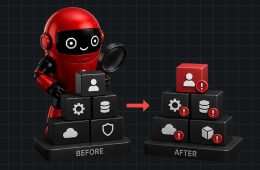
In cloud security, identities have become the new perimeter.
Whether it’s a developer with administrator access, a forgotten service account, or an application with permissions it no longer needs, over-privileged identities are one of the most common—and most overlooked—security risks in AWS, Azure, and Google Cloud.
The problem isn’t usually that permissions are granted incorrectly. It’s that they’re rarely removed.
Over time, access accumulates. Employees change roles, projects end, applications evolve, but permissions stay the same. This “permission creep” quietly expands your attack surface and increases the impact of a compromised account.
Quick Answer
Over-privileged cloud identities are users, service accounts, or workloads with more permissions than they need. You can identify them by reviewing IAM roles, analyzing actual permission usage, auditing inactive accounts, and monitoring privileged access. The best long-term approach is to enforce least privilege, automate access reviews, and continuously monitor identity risks across AWS, Azure, and GCP.
What Is an Over-Privileged Identity?
An over-privileged identity has access beyond what’s required to perform its job.
This could include:
- A developer with full administrator rights.
- A service account with access to every storage bucket.
- A contractor whose privileged access was never removed.
- An application using broad wildcard (*) permissions.
These permissions may never be abused—but if the identity is compromised, the attacker inherits those same privileges.
Why Permissions Keep Growing
Over-privileged identities are usually the result of normal business operations.
Common causes include:
- Employees changing roles.
- Temporary access that becomes permanent.
- Projects ending without access cleanup.
- Copying existing IAM roles instead of creating new ones.
- Service accounts that are never reviewed.
The result is permission creep—where identities gradually accumulate access over time.
How to Identify Over-Privileged Identities
Review High-Privilege Roles
Start by identifying users and workloads assigned administrative or broad predefined roles.
Look for roles such as:
- AWS AdministratorAccess
- Azure Owner or Contributor
- GCP Owner or Editor
Not every administrator account is unnecessary, but every one should have a clear business justification.
Compare Granted Access with Actual Usage
One of the easiest ways to find excessive permissions is to compare:
What an identity can do
vs.
What it actually does
Many cloud providers offer native tools to help with this:
- AWS: IAM Access Analyzer
- Azure: Microsoft Entra Permissions Management / Defender for Cloud CIEM
- GCP: IAM Recommender
These services identify permissions that haven’t been used and recommend rightsizing access.
Audit Service Accounts
Human identities usually receive regular attention.
Service accounts often don’t.
Review:
- Old API keys
- Unused service accounts
- Long-lived credentials
- Applications with broad permissions
In many cloud environments, machine identities now outnumber human users, making them an increasingly important security focus.
Look for Dormant Accounts
Inactive identities create unnecessary risk.
Review accounts that:
- Haven’t logged in recently.
- Haven’t accessed cloud resources.
- Belong to former employees or contractors.
- No longer support active workloads.
If an identity isn’t being used, it shouldn’t retain privileged access.
How to Reduce Excessive Permissions
Apply Least Privilege
Every identity should have only the permissions required to perform its current responsibilities.
Avoid assigning broad roles simply because they’re convenient.
Instead:
- Use role-based access.
- Create custom roles where appropriate.
- Limit permissions to the smallest possible scope.
Least privilege remains the foundation of secure cloud IAM across AWS, Azure, and GCP.
Replace Standing Privileges with Just-in-Time Access
Not every administrator needs permanent administrator rights.
Where possible, grant elevated permissions only when they’re needed and revoke them automatically afterward.
This reduces the window of opportunity for attackers while still allowing administrators to perform privileged tasks.
Schedule Regular Access Reviews
Identity governance isn’t a one-time project.
Review privileged access regularly by asking:
- Does this user still need access?
- Is this permission still being used?
- Does this service account still exist for a valid reason?
Small, frequent reviews are much easier than large annual cleanups.
Monitor Permission Drift
Identity permissions change constantly.
Without continuous monitoring, excessive privileges quietly return.
Monitor for:
- New administrator assignments
- Privilege escalation
- Unused permissions
- New service accounts
- Changes to IAM policies
Continuous monitoring prevents today’s cleanup from becoming next year’s problem.
Common Mistakes
Avoid these common pitfalls:
- Giving developers permanent administrator access.
- Forgetting to remove contractor accounts.
- Ignoring service account permissions.
- Reviewing identities only before audits.
- Assuming predefined roles follow least privilege.
These mistakes are easy to make but can significantly increase cloud risk.
How Cloud Aran Helps
Cloud Aran helps security teams identify identity-related risks before they become security incidents or audit findings.
By continuously monitoring AWS, Azure, and GCP environments, Cloud Aran highlights excessive permissions, tracks identity-related security risks, and provides centralized visibility into cloud posture. Instead of relying on periodic IAM reviews, teams can continuously identify permission drift and prioritize high-risk identities across their cloud environment.
Frequently Asked Questions
What are over-privileged cloud identities?
These are users, service accounts, or workloads with more permissions than required to perform their intended tasks.
Why are excessive IAM permissions dangerous?
If a privileged identity is compromised, attackers inherit all of its permissions. The broader the access, the greater the potential impact.
How often should IAM permissions be reviewed?
High-risk identities should be reviewed continuously or at regular intervals rather than only during annual audits. Continuous monitoring helps detect permission drift before it becomes a security issue.
Conclusion
Most identity risks don’t appear overnight—they accumulate over time.
Permissions are granted, projects evolve, and accounts remain active long after they’re needed. Without regular reviews, organizations slowly drift away from least-privilege access.
By identifying over-privileged identities, reviewing actual permission usage, and continuously monitoring IAM changes, organizations can reduce their attack surface while improving both security and audit readiness.